


Worksheet 4 - ISDN Networking
There are two types of ISDN service available throughout the world: Basic Rate Interface and Primary Rate Interface. BRI service is by far the most common and is typically found in homes and businesses alike. The higher capacity PRI service is a central-site solution for extending applications to large numbers of remote users, who communicate through their BRI connections.
In BRI service at an office or a home, the ISDN line consists of the same
twisted pair of wires traditionally
used for analog telephones.
Numerous ISDN devices can
connect to this single line.
The BRI line provides two types of ISDN communications channels:
two "bearer service" B-channels, which carry data and services at 64 Kbps (or
combine
for 128 Kbps), and a single, 16 Kbps D-channel, which usually carries signaling
and administrative
information used to set up and terminate
calls. Up to eight ISDN devices
can be connected to a single BRI line, and can all share the B-channels and D-channel.
Individual devices are distinguished through the use of multiple
subscriber numbers, with a different ISDN number
assigned
to each device. D-channel signals automatically
route
communications to the appropriate
ISDN device.
Although only two B-channels are available at any point in time,
numerous
other calls may be put "on hold" via
D-channel signaling,
a feature referred to as "multiple
call appearances".
ISDN PRI includes 23 B-channels in North America and Japan (30 B-channels in
most of the rest of the world), plus one 64 Kbps D-channel. The number of B-channels
is limited by the size of the standard trunk
line, which is T1 in North America and Japan and E1 elsewhere. Unlike
BRI, PRI does not support
a bus
configuration,
and only one device can
be connected to a PRI line. A PBX, however, can reallocate
ISDN PRI resources onto multiple
BRI buses.
A single PRI connection
is usually much less expensive than obtaining
the equivalent number of B-channels through multiple
BRI connections. The primary benefit of PRI is that its
bandwidth
can be dynamically allocated
among applications.
For example, certain channels
can be allocated for voice calls, but as those calls are terminated,
the unused B-channels can be reallocated
to such high-bandwidth applications as videoconferencing. This is usually accomplished
via
a PBX or a server capable
of distributing
the T1/E1 bandwidth
on a PRI link.
With its BRI and PRI services, ISDN has the flexibility to meet the bandwidth needs of a home office, branch office, or company headquarters. A small office can use ISDN BRI to support all of its voice and data communications requirements. In a larger office, multiple ISDN BRI lines can be divided among multiple users and applications via a server or PBX. And users in a very large office can benefit from ISDN PRI's capacity to provide a large quantity of multiple B-channels.
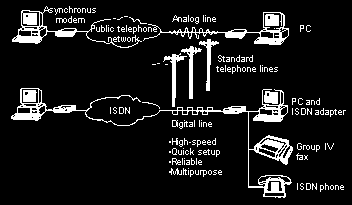
Analog vs. digital ISDN Connections
|
Both the text and the picture have been provided by
courtesy of the ISDN Zone which is an Eicon Technology Presentation. Copyright © Eicon Technology Corporation |
Note: The Worksheet 5 contains detailed information on B-channels and D-channels. Thus is a logical continuation of this worksheet.
If you want to practice your listening and pronunciation, listen to the text using the audio player below.
Notice the British accent of the speaker!