


Worksheet 5 - ISDN Networking - B-Channels and D-Channels
B-channels are logical
"pipes" in a single ISDN line.
Two B-channels can be combined
to download data at very
high speeds to a PC. One of the B-channels can also be freed up for another
device, such as a telephone
or fax machine, with the remaining B-channel
used for data transfer.
Each provides a 64 Kbps clear channel whose
entire
bandwidth
is available for data, since call setup and other signaling
is done through a separate D-channel.
Although B-channels are normally used for on-demand connections,
taking full-advantage of the circuit-switched
networks upon which they are based, they can also be configured
as semi-permanent or "nailed-up" connections which are
always "up", much like a leased-line.
This can cause a capacity
problem for carriers and Internet
Service Providers that is solved by an emerging
standard called Always On / Dynamic ISDN (AO/DI).
The ISDN D-channel is used mostly for administrative signaling, to instruct the carrier to set up or terminate a B-channel call, to ensure that a B-channel is available to receive a call, or to provide signaling information for such features as caller identification. The D-channel uses packet-switched connections, which are best adapted to the intermittent but latency -sensitive nature of signaling traffic, thus accounting for the vastly reduced call setup time of 1 to 2 seconds on ISDN calls (vs. 10 to 40 seconds using an analog modem). The D-channel transmits at either 16 Kbps (for BRI service) or 64 Kbps (for PRI service).
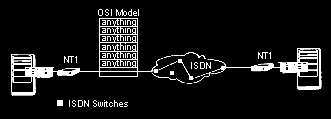
Circuit-switched B-Channel Connections
|
Both the text and the picture have been provided by
courtesy of the ISDN Zone which is an Eicon Technology Presentation. Copyright © Eicon Technology Corporation |
Note: This worksheet is a logical continuation of the Worksheet 4.
If you want to practice your listening and pronunciation, listen to the text using the audio player below.
Notice the British accent of the speaker!